Showing posts with label school. Show all posts

Thursday, May 22, 2014

Ranch Turned School

View towards La Junta from the back of the ranch

Recently the school I work for bought a former ranch that housed troubled youth and provided them with rehabilitation in various forms. The ranch opened in 1959 and provided training in careers such as mechanics, printing, basic veterinary services, general ranching, and many others. In 2012 the ranch lost its funding and had to be shut down. GOAL Academy, my school, bought the ranch with TABOR funds. These funds were set aside as required by law to help with maintenance of school buildings, but since we are an online school there was no where to spend the money. By accident the sale of the ranch came to the attention of the CEO of GOAL. After much discussion and negotiating the ranch became school property.


I had the privilege of attending a recent conference at the new site. We were given a tour and short history of the ranch by the manager. The brain child of several Colorado judges, seeing a need to help the growing population of troubled teens, for 52 years the ranch provided rehab and training for thousands of young men. It is located near La Junta, Colorado (which mean The Junction), which lies along the Santa Fe trail; cows would be herded over the land toward Pueblo, Colorado or New Mexico to be shipped east. There are approximately 37 buildings on the small 30 acre corner of the 317 acre land mass.

Sign near the small animal pens
A view of my room

Many of the buildings are fitted as classrooms, others are set up specifically to meet the needs to the training occurring in that building. There is a gym with an attached weight and game room. Greenhouses, horse stables, animals pens, dorms, and many others.

Print shop, maintenance, etc.

The library was built by former attendees of the ranch. The students would study plumbing, wiring, structure support (basic architecture) and other aspects for building. Then work together to make a plan for the library. Eventually, they worked together to actually build it. Master plumbers, electricians, etc. were brought in to ensure the integrity of the work. The building is now a standing tribute to the work these students were willing to put in to achieve a common goal.

The library and meeting rooms

The chapel on the grounds was donated by the town of Arlington, Colorado. Built in 1916 it represents the common architecture for that era. In May 1967, it was moved 27 miles to rest at the southwest corner of the ranch.

Arlington Chapel

GOAL will use the ranch to supply Career & Technical Education (CTE) to our students. It will allow us to provide the "high touch" part of our online program. As the ranch is brought back up to meet fire codes and safety codes it will be available for outside entities to rent the space.


Sculpture near horse stables

Friday, December 13, 2013

Independence Day is Approaching

This week at school we are celebrating Kazakhstan history. December 16 and 17 are Independence Days, so leading up to it we are treated to information about Kazakhstan and its presence in history and today. Several times a day, students come over the intercom system and give us information about Kazakhstan, in Kazakh, Russian, and, sometimes, English. One of the tidbits I remember is the fact that Kazakhstan is the 9th largest country in the world, and that English is an increasingly important language to learn.


 To kick off the week, students created a presentation in the auditorium. There was dancing, poems, informative quotes, and even dombra  playing! It was very entertaining.


I’m looking forward to seeing what Shymkent has in store as far as celebrations for Monday and Tuesday. I’ll be sure to keep you posted.

Thursday, December 5, 2013

The First Real Snow Day in Shymkent!

            Today was the first real snowy day in Shymkent. We’ve had a dusting of snow that did not stick to the ground, especially the streets, for long, but last night we had an accumulation of snow. Of course, I thought that I would come here and buy boots for winter, but come to find out my feet are too big for the shoes they offer, so I’ve been stuck. It would have been handy to have those boots today because I walked through quite a bit of slushy snow to get around my building and to the street to find a taxi. Thankfully, the taxi driver we’ve been using quite frequently was there waiting for me. I walked right up and got in his toasty warm car (bonus to not having to warm up my own car!).
Those tiny dots just above the light post are people.

            The roads were thick with slushy snow and we started on our way. Along the sides of the streets is a ditch about half a meter (1.5 feet) deep. As we were driving I kept thinking, “I can’t really see that ditch and it is pretty slick out here. I wonder if anyone ever slides right into one.” The taxi driver took his time along the roads and didn’t rush up on anyone and even let someone merge from the side of the road, so I knew that I would make it to school safely. Just like at home, there is no one to shovel off sidewalks, so a lot of people were walking along side the road. Several of them looked as if they’d been splashed by the mud and snow. Also, I think this is true for most days, but there were a lot of cars just parked on the side of the road. It’s more noticeable when two lanes become one and everyone is squeezing around those parked awkwardly on the side.
            The windshield wiper on my side didn’t quite clear the whole windshield so I was left with blurry snow vision all the way, but I tried to squint out to see where we were headed. It’s still pitch black here at 7:30 am, so that was a trial too. Half way to school I saw three plows going along the other side of the road; I can only imagine those guys have been out all night!
Out the window of my office.

            As we approached one stop light the taxi slide a little bit and the driver made the classic mistake of NOT turning into the slide. He quickly corrected the wheel and by the time we were done sliding the car was still facing the right way. At the bottom of the hill from school I could see a group of people huddled around a car. Once we were close enough I could see that the front passenger wheel of the car was in one of those huge ditches, well, that answers my previous quandary! It is difficult to discern what happened but I can assume that the driver was attempting to turn from one street to the next and under estimated the location of the ditch. Bummer!
            The road in front of the school was jammed packed with cars going up and down. Two cars sat facing the same way but on opposite sides of the road and directly across from each other, thereby creating a one-way street between them. As we turned onto the road we got stuck behind a line of cars waiting to pass through the one-way. I could see the road was very slick here. Our line began to move and we crept passed the two cars and up the hill. About half-way up we had to stop again, but this time the car wasn’t having it and we were stuck. The driver tried with all his might – uh, pushing the gas pedal as hard as he could – but our tires just spun like crazy with no traction. I figured he would try to back up and start again, but he just looked at me and raised his hands and shrugged his shoulders. That means it’s time for me to get out. I paid the fare, stepped out into a snow bank, and trekked the rest of the way up the hill to school. No complaints here, at least I made it that far without incident!
The school courtyard.

            The hillside trek wasn’t too bad, even in my sneakers. There was a nice path right up the middle of the sidewalk carefully carved out by all the walkers before me. I stepped into line with several other people and tried to keep pace. I survived and have lived to tell this tale, and that’s the story of my first snow day in Kazakhstan.


(PS Through the weekend it will be in the 40s and by Monday it will be back in the 50s again, so pretty much just like Denver!)
That's a chilly jungle gym!

Thursday, October 31, 2013

A View from Home

About a week and a half ago, my mother-in-law gave a speech about Kazakhstan to her fellow townsfolk. She wrote out her whole speech to help her prepare and shared it with us. With her permission I am posting her writings about Kazakhstan and her view of it from home. Please feel free to leave comments for her and we'll be sure to pass them on:

Yearbook Theme – Seeking Growth Today – Doing the Things We Love

When we came up with that theme, I thought everyone, including me, would talk about their hobbies.   So, I thought, do I want to talk about fly fishing?—no, not really.  Golf, no, not really.   Another thing I like to do is read, and right now I am reading Apples are from Kazakhstan.  (Apples, we just love ‘em?)  It’s true, botanists have traced back the beginning of the apple tree to this Central Asian country.  Wild apple trees grow in some regions, and the fruit covers the ground in the fall.  They have an apple in KZ called the Aport which grows as big as a baby’s head and is sweet and delicious.   Tulips are also from KZ and trousers.    But KZ is a land that no one knows much about.  But I’m not really going to do a book report.  I am going to tell you WHY I am reading this obscure book about this obscure country.

You know how wonderful it is to HELP your children, grandchildren and nieces and nephews grow?   And then all of a sudden, some of them are doing things you never even dreamed of, and all of a sudden, they are helping YOU grow.    My middle son Levi—the quiet, artistic, introverted, son, and his wife April—have opened my eyes, widened my horizons, and made me seek growth. 

About five years ago, when most of us in this country were still reeling from 911 and harboring some real fears of Islamic people,  April took at job in the United Arab Emirates, in Abu Dhabi, at a charter school where her uncle was the dean.  It was an all boys school, and she mostly worked with the teachers telling them about how schools in our country teach Math.  The next year they moved to Dubai.  There Levi worked for a magazine as a graphic designer.  The UAE is pretty bilingual, so they got along ok speaking only English. This is what April wrote to me about the Middle Eastern people:

   The people I met were so incredibly nice and curious about America; I never felt any hostility from anyone (OK, maybe a bit during Ramadan on the road - but who wouldn't be cranky when they've worked a full day on an empty stomach!). The teachers I worked with were willing to let me into their classrooms, which is a feat for teachers around the world to let someone in their space.  They spoke to me with respect (which of course I returned). They wanted to teach me about their culture and their language. Many of them commented how awful the Taliban is and how they are not liked by most of the Islamic community.  From these stories and interactions I knew that I wanted to spread the word to Americans about how much we stereotype Muslims. 

So, they came back home and bought a house and a dog, and April got a job at GOAL Academy on-line school. Levi went back to his graphic design job here.  But then they got restless to do it again, so April starting looking for another international teaching job.  In July Levi called to tell me they would be moving to Kazakhstan in three weeks.  Where?  I didn’t even know where Kazakhstan WAS.  It’s there, point down, 12 hours ahead [as she stands in the USA].  And here they were going all by themselves, not knowing anyone, not knowing the language.   Getting their Visas took longer than expected, but finally they got there, about 3 weeks ago, with their little pug dog.  April’s job is at a Gifted and Talented high school, and she will be teaching Math in English.  Almost no one in KZ speaks English, most speak Russian, although many speak Kazakh, but they are teaching their brightest students in all three languages.  The government sends 3,500 students abroad to university on a full scholarship plus living expenses on the condition they will come back to work for only three years.

KZ is the 9th largest country in the world.  Texas can fit in it 5 times, and it’s larger than all of Western Europe.  It is located West of China, South of Russia, and bordered on the west side by the Caspian Sea.  Turkmenistan, Uzbekistan and Kyrgyzstan border it to the South.  It is approximately the same latitude as the Northern United States.  Levi & April are in Shymkent, a city about the same climate and size as Denver.  There are only a few cities in KZ.  It is a Republic government.  President Nazarbayev was elected as the first President when the country became independent from the Soviet Union and he has been in office over 20 years.  The Kazakh people seem to like him and they keep reelecting him.  Its historic culture is that of nomads living in yurts.  Under Russian rule, the people were forced to settle and farm.  Then the Soviets in the 1900s ruled the country and built large communist-styled bloc apartment buildings and factories.  Levi & April live in one of those old style apartment buildings.   It’s big and comfortable, and they have great, fast internet service, but no dishwasher, no clothes dryer, and the refrigerator is in one of the bedrooms. 

The present Capital city Astana is 1,000 miles away with nothing but steppe in between.  Astana is a brand new, very modern city built in the middle of the country just in the last twenty years, since the fall of the Soviet Union in 1991. Many different nationalities live in KZ now, most of whom were forced there by the Soviet regime or came as refugees from wars in their countries.  Different cultures get along and accept one another, having past hardships in common.   About half of the people are Muslim and half are Russian Orthodox, but nearly everyone is moderate, not devout or extreme in their religious traditions.  They wear western clothing.  And they love music and love to dance.  The students at April’s school flash mob and line dance during their breaks.  

Levi tells me it is not just for the adventure that they have chosen to experience other cultures.  They wanted to challenge themselves by getting out of their comfort zones.  They wanted to see people from a different angle.  It has made them appreciate what we have in the U.S., and not take it for granted.  And it has made them relate to people who don’t speak our language, to experience being on the other side of the language barrier, how to communicate with few  words.   My kids are aware that they are representing Americans, and they try to be their best and break the stereotypes many people have of Americans.  I am so proud of them because I think it takes courage to do this just as regular people, not as part of an organization with an agenda, and not with a tour guide.  I can’t imagine doing it myself.  They are meeting real folks, not just service employees in tourist destinations. 


The most surprising thing my son told me is this:  Being in a completely new place makes you focus on the details, the things you take for granted at home.  That slows down time, and makes you live longer.         Well, we can’t all travel to the other side of the world, but we can all get out of our comfort zones, and experience something new.    Dosvedania!

Monday, October 7, 2013

School Smool


School, for local teachers and students, is Monday through Saturday, 8:30 am to 3:55 pm. Fortunately for me, the international teachers only have to work Monday through Friday, 8:00 am to 5:00 pm (sometimes until 6). The local teachers also stay later throughout the week for IELTS (English language) training, professional development, extra curricular activities with students, or other various activities with the school. Students also stay late for extra curriculars, IELTS (just 11th graders), or other activities. 120 of the 500 students actually live at the boarding school attached to the back of the building.

           The Nazarbayev Intellectual School system was created to help support gifted and talented students. Each student is expected to attend university when they graduate – either at home or abroad. Their schooling is paid for as long as they commit to working in Kazkhstan for 5 years after to the earning their degree. All of the students in our school are from the surrounding province known as Southern Kazkhstan and because some students do not live close by there is boarding school provided. Every student is given a FREE breakfast and lunch everyday (even non-boarding school students). The cafeteria is also open between meals so students can pick up some water or a snack in between classes.

            My morning starts off with a taxi ride at 7:30 am to the school, I ride with just one of my co-workers now, but we suspect that as new teachers arrive we may have company. Monday mornings at 8 am, the students assemble in the front courtyard for the national anthem and announcements. Tuesday through Friday the 11th grade students report to the auditorium at 8 am for English debates (meant to prepare them for IELTS and it helps to make them globally aware of hot topics throughout the world).

Game tables in the hallway.


            Throughout the school day I visit teachers in their classrooms to observe or help teach a class. Since this is just the beginning of my second week I have only been observing. My hope is that this week I’ll get to do some teaching! Right now I’m mainly working with 11th grade students (as this is the nation-wide focus right now). There are 3 of us international math teachers, and I’m still unsure as to how many local 11th grade math teachers there are, but if I had to guess I’d say around 5. 11th graders take math 6 class periods a week and they are in the midst of learning basic calculus. The past few years I’ve been accustomed to teaching middle school math, so I have to brush up on my calculus!
            Right now I’m working in a general teacher’s workroom, but we are hoping for a math workroom soon. It would be nice to be in the same area as math teachers to interact with them more frequently.
           
Between 11:55 am and 12:15 pm, the students have flash mob. The dance teachers have choreographed a 15 minute dance to a mash-up of songs. The students assemble in the court yard (each one standing on a blue dot painted on the ground) and follow along to the dance. I’m a little curious as to how this is going to look when the weather turns too cold to go outside, but for right now I think it’s a great way to break up the school day for students.
            I have been eating my lunch at school everyday. It has never cost me more than $3.50 for a full meal of starches, meat, and sometimes a salad of cucumber and tomatoes or coleslaw, plus a bottle of water. In the morning, if I forget to bring my own water, I will go and pick one up at the cafeteria for $0.50. Last Friday, 4 October, I sat with a co-worker from Malaysia and a local teacher who spoke English very well. We were discussing the price of lunch and they both agreed that lunch is expensive here. I’m concerned about what they are paying the teachers here if that is expensive L My husband and I were discussing how $3.50 is about half or a third of what we were paying for lunch in the US everyday. My one concern with the food at the cafeteria is that it might get old, as in, they pretty much make the same thing everyday. Although there are choices, sometimes potatoes and rice, other times rice and noodles; meatballs or meatloaf lasagna (well, that’s what I’m calling it anyway); there may be two starch choices and then three meat choices, but they don’t seem to vary as to what they are. As I get more comfortable with cooking and buying food at the market, I’ll probably start to vary my lunches a bit.
The Canteen (cafeteria!)

            The classrooms in the building look just like ours in the States – rows of desks, with a teacher desk and whiteboard at the front of the room. The teachers do not have posters up on the walls, but do have one display type of bookshelf that have 3D shapes and a few books on them. Each classroom has a Promethean board. My fellow teachers will know what that is, but in short, it’s a smart board. Teachers can display presentations on it, use it as a whiteboard, or have students write with special markers directly on the presentation or blank Word Doc to be saved for later. I’m sure there are other uses, but I have yet to discover those for myself and it seems the teachers here do too.
 The classes are set for 40 minutes, but the 11th grade math students sit for back-to-back periods making their math class 80 minutes long. I’ve found that many of the local teachers do not know how to fill the time and therefore tend to give 20 minute tests during the last part of the class. Also, the classes are very teacher-centered, so it is a long, hard task of encouraging more student-centered learning.


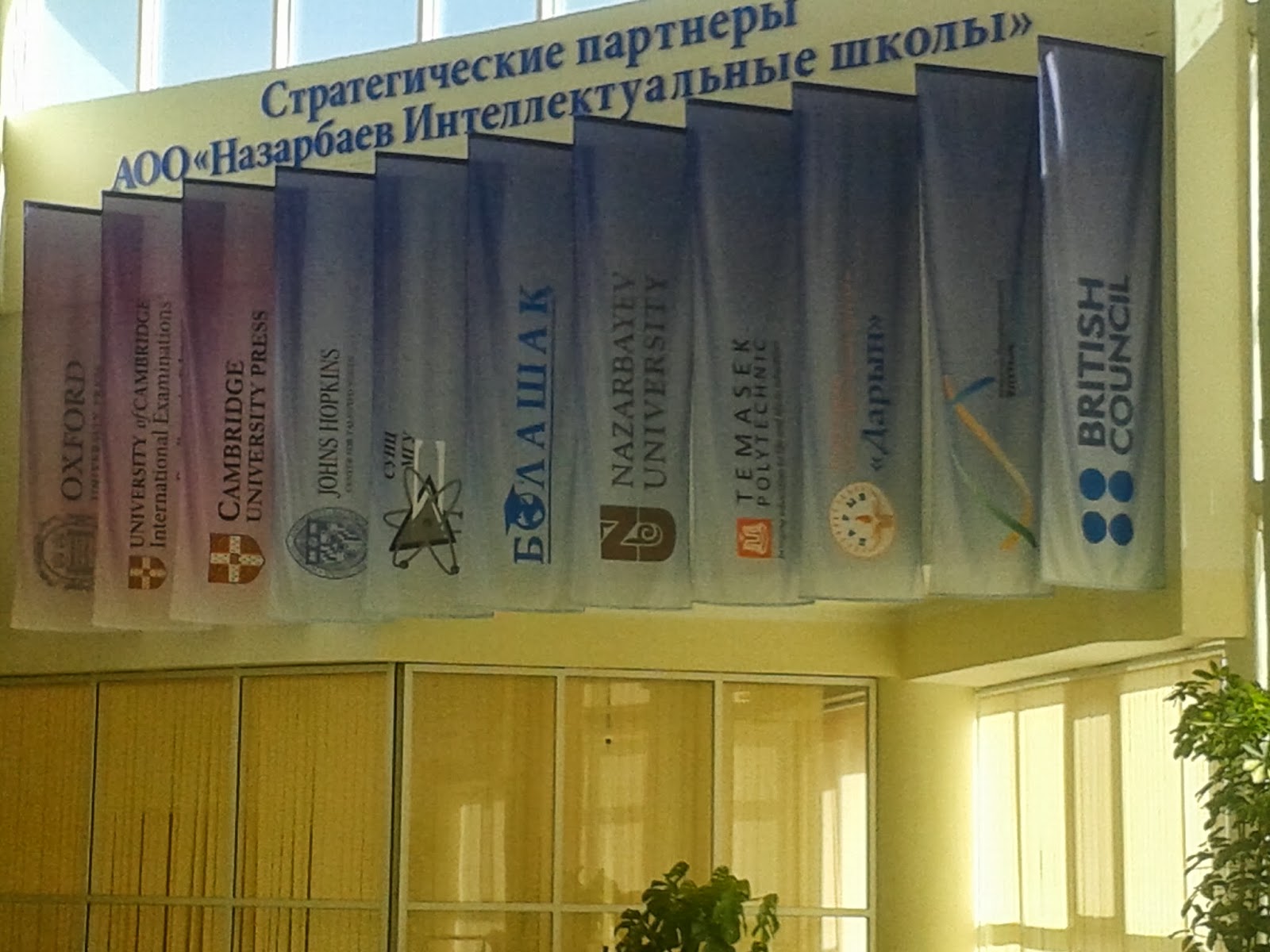
Sponsors to the NIS program.


            I’ve been asked several times why Americans were chosen for assisting in improving schools in various countries. I guess it never occurred to us that our schools are doing a good job. The teachers spend 10 hours a day (sometimes more) grading, planning, participating in extra curricular activities, mentoring students, going back to school themselves, etc. etc. and all that work really is paying off. Our students are smart, our classrooms are full but we are managing to relay an education to them. There are always improvements to be made and when we start comparing ourselves to countries that track their students, then of course it looks like we are not doing a good job, those countries send test results for students that have been specially selected to go onto college. Every system is flawed and that is why I have my job today. I think the rest of the world can look up to Western education in general (Western including Australia, UK, New Zealand, Canada, the US, etc.) because we do strive to give our students the best and we never stop!

Mural on the second floor near the math and physics department.

Kazakhstan's constitution and a bust of President Nazarbayev.